Winter is Coming
What nature, neuroscience and a few rather busy squirrels might teach us about the darker months ahead.
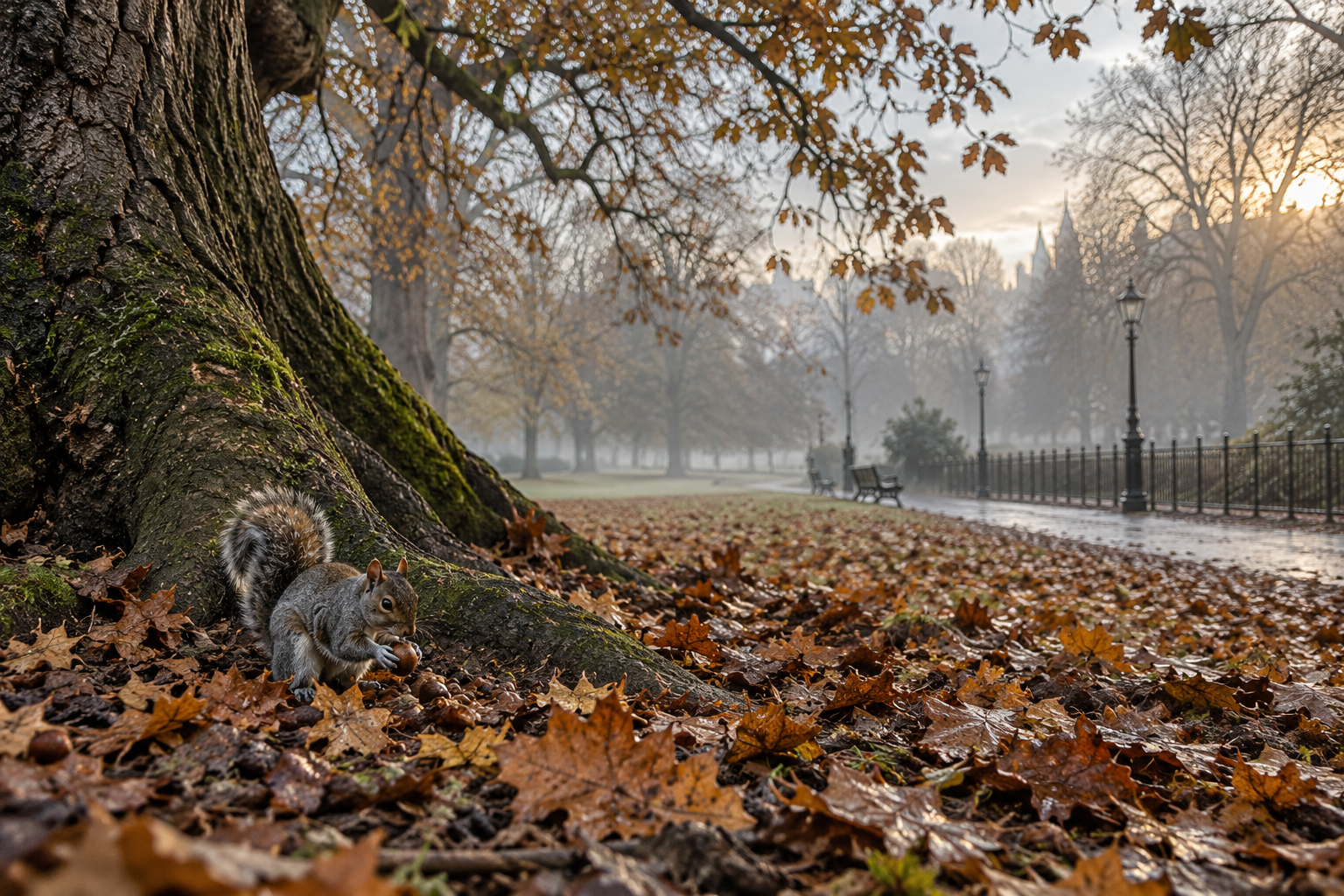
A season of preparation in a London park. AI-generated editorial image.
There comes a point in October when autumn stops feeling decorative and starts feeling practical. The mornings are darker, the temperature drops and somewhere around late afternoon there is the slightly surprising realisation that somebody appears to have switched the day off early. Activities that felt effortless a few months ago begin to require more negotiation. An evening run becomes less appealing. Going back out after dinner requires a stronger argument. The sofa, meanwhile, has prepared an excellent counterproposal.
We often notice this change in ourselves and immediately turn it into a question of motivation. Why am I more tired? Why am I doing less? Why does everything seem to require a little more effort? Sometimes there will be other reasons, of course, but it is also worth remembering something fairly obvious: the environment around us has changed and human beings are biological organisms living inside it.
There is perhaps something reassuring in remembering that we are not the first generation to notice winter approaching. For thousands of years, people have watched the daylight retreat, felt the temperature fall and adjusted their lives accordingly. Our ancestors were considerably more dependent on the seasons than we are today, but the underlying biological systems that help us respond to light and darkness are still very much with us.
The Brain Knows What Season It Is
Light does considerably more than help us see where we are going. Specialised cells in the retina send information about environmental light to the brain's central circadian clock, a small region within the hypothalamus called the suprachiasmatic nucleus. This helps coordinate our sleep-wake cycle, body temperature, hormone rhythms and daily patterns of alertness. Light is, in effect, one of the ways the outside world tells the brain what time it is.
As the days shorten, those signals change. Morning light arrives later and darkness falls earlier. Melatonin, a hormone involved in signalling biological night, is strongly influenced by light exposure. Our internal rhythms can therefore shift as the seasons change, although how much this affects sleep, mood and energy varies considerably between people.
One small but interesting study followed ten healthy men across five consecutive seasons, measuring their sleep, body temperature and melatonin rhythms. The researchers found seasonal differences in circadian timing, with sleep and waking occurring later in winter than in summer. It was a small study, so we should be cautious about generalising too widely, but it offers a useful glimpse of how seasonal conditions may be reflected in the body's internal clock.
There is also something rather fascinating happening at the level of brain activity itself. In a 2016 study published in Proceedings of the National Academy of Sciences, researchers used functional MRI to examine how the brains of 28 healthy young adults responded to attention and working-memory tasks across the year. Participants spent several days in carefully controlled conditions without normal seasonal cues before being scanned.
Their performance on the tasks remained broadly stable, but the patterns of brain activity supporting that performance varied with the seasons. For sustained attention, neural responses were highest around the summer solstice and lowest around the winter solstice. Working-memory activity followed a different annual pattern, with its peak around autumn.
This does not establish that our brains work less effectively in winter, nor that they necessarily use less energy. The study was relatively small and measured different people at different points in the year. Nevertheless, it raises an intriguing possibility: even when our outward performance remains similar, the neural processes supporting it may vary with the seasons.
In other words, the brain may be doing something rather more interesting than simply carrying on as usual beneath the same winter coat.
Nature Has Been Preparing for Weeks
If we look outside, much of the natural world has already begun making arrangements. Trees are shedding leaves, plants are redirecting resources and animals are adapting their feeding and activity patterns. Some species migrate, some reduce their activity and others enter torpor or hibernation to conserve energy when conditions become demanding.
And then, of course, there are London's grey squirrels.
Anyone with a garden, a bird feeder or a passing acquaintance with a London park will know that these animals appear to be approaching autumn with the intensity of a small logistics company experiencing a particularly difficult quarter. Nuts are collected, buried, occasionally dug up again and relocated. Flowerpots are investigated. Recently planted bulbs may be treated as a personal invitation. Grey squirrels do not truly hibernate, but their autumn food-caching behaviour is an excellent example of preparing for a season when resources may become less readily available.
Despite their apparent commitment to interfering with our gardening plans, there is something useful in their approach. They are not waiting until January to discover that winter has arrived. They are responding to changing conditions now.
Nature, generally speaking, does not seem particularly embarrassed about these adjustments. An oak tree does not spend February worrying that it was considerably more productive in July. It has a different job to do.
Humans, however, have developed a rather unusual arrangement.
When the Drive System Ignores the Weather
Heating, electric lighting and technology allow modern life to continue almost unchanged throughout the year. We can work late, exercise late, shop late and answer emails at almost any hour. The practical differences between summer and winter have become less obvious, particularly when much of our day is spent indoors.
Our expectations, meanwhile, tend to remain remarkably consistent. Deadlines do not reduce because the days are shorter. School runs still happen. Targets remain. And as winter approaches, Christmas often introduces an entirely new collection of demands, spending and social obligations.
From a Compassion Focused Therapy perspective, this creates an interesting tension between our motivational systems. The drive system helps us pursue goals, achievement and rewards. It gives us momentum and a sense of purpose. But when our energy or enthusiasm changes, drive may respond by insisting that we simply need to try harder.
The threat system can then join in, interpreting a quieter pace as laziness, weakness or evidence that something is wrong. What began as an ordinary fluctuation in energy becomes a reason to criticise ourselves.
Of course, we do not need to abandon our goals simply because the evenings are darker. Regular movement, relationships, meaningful activity and time outdoors remain important, particularly when mood is low. But perhaps we can be a little more flexible about the scale of what we expect ourselves to do.
The direction can remain the same while the dose changes.
A long evening run might become a shorter walk in daylight. A packed weekend might become lunch with one friend. A major home project might become one useful job rather than six. We can continue moving towards what matters without insisting that every activity requires the same amount of energy, enthusiasm or ambition throughout the year.
There is a difference between losing direction and changing pace.
The Winter We Expect
There is another layer to this, and it concerns what we expect winter to be like before it has properly arrived.
Our brains do not simply receive information from the world. They also use previous experiences, memories and expectations to anticipate what might happen next. In predictive processing accounts of perception and behaviour, the brain is continually generating predictions and updating them in response to incoming information.
This can be enormously useful. If we have previously found winter difficult, our brains may begin anticipating some of those difficulties as soon as the familiar cues appear. Darker mornings, colder weather and shorter evenings can become associated with tiredness, low mood, isolation or the familiar feeling of having too much to do and too little energy.
Sometimes these expectations reflect genuine experience. But they may also influence what we notice and how we interpret it. A tired Tuesday evening in June might be explained as a busy day. The same experience in November might become further evidence that we always struggle in winter.
The story we tell ourselves matters.
If winter is something we dread, we may begin approaching it with tension, frustration or a sense of inevitable decline. If, instead, we see it as a season that asks for different arrangements, perhaps there is more room for curiosity and choice.
This is not about pretending to enjoy darkness or thinking ourselves out of seasonal depression. It is about recognising that our expectations can become part of the experience itself. We can acknowledge that winter may bring genuine difficulties without deciding in advance that the entire season must be a struggle.
Learning Not to Force It
There is a useful idea within Daoist philosophy that fits rather nicely here. Wu wei is often translated as non-action, although that makes it sound rather passive. It is more accurately understood as acting without unnecessary forcing, working with the conditions that exist rather than continually struggling against them.
Water does not become weak because it flows around a rock. It simply responds to the landscape.
Winter may invite something similar from us. Instead of asking how to remain exactly the same person we were in June, we might ask what the season requires now. This might mean moving some exercise earlier, protecting opportunities for daylight, making evenings quieter or becoming more selective about commitments.
It is not about doing nothing. It is about noticing when effort is useful and when we are spending considerable energy fighting against circumstances that could be approached differently.
Winter Has Always Been Something We Do Together
There is another aspect of winter preparation that we can easily overlook. Traditionally, adapting to winter was rarely an entirely individual undertaking.
Across different cultures, the colder months brought changes in food, work, gatherings and daily routines. Outdoor activity often gave way to indoor work, food was preserved and seasonal rituals helped communities mark the transition. People prepared homes, gathered resources and created ways of sharing warmth and company.
In Nordic countries, the idea of hygge is often reduced to candles, blankets and attractively expensive mugs, but its broader appeal lies in creating comfort, familiarity and connection during darker months. In Japan, the kotatsu, a low heated table covered by a quilt, provides warmth while also creating a natural gathering place for eating, talking and spending time together.
These are not simply ways of keeping warm. They are ways of organising life around the season.
There is something psychologically important about that shared experience. Winter becomes less of a private battle with our motivation and more of a collective transition. We have been doing versions of this for generations. We might have central heating, insulated homes and rather better waterproof jackets, but we still benefit from warmth, routine, companionship and a sense that we are moving through the darker months together.
Perhaps one of the difficulties of modern winter is that we have become rather good at removing the obvious signs of the season without necessarily replacing the rituals that once helped people adjust to it.
Preparing Rather Than Enduring
Wintering well, then, might begin before winter itself. Not with a dramatic lifestyle overhaul, but with a few thoughtful changes to the way we organise our days and the expectations we carry into them.
It might involve making morning daylight a little more important, particularly when darker mornings make waking difficult. Perhaps we adjust the timing of exercise, protect opportunities for social connection or create some quieter evenings rather than filling every available hour. We might also think about the things we genuinely enjoy about winter, whether that is cooking, walking in cold bright weather, reading, seeing friends or simply making home somewhere pleasant to return to.
There is an important distinction here between adapting to winter and withdrawing from life. Persistent low mood, significant loss of pleasure, hopelessness or noticeable deterioration in everyday functioning should not simply be dismissed as a natural seasonal response. Seasonal Affective Disorder is real and effective treatments are available. Sometimes we need more than a warmer jumper and a change of routine.
But equally, not every reduction in energy or enthusiasm needs to become a personal failing. Nor do we need to maintain identical levels of activity throughout twelve months of changing environmental conditions.
Perhaps preparing for winter is partly about deciding what we want to preserve. Movement, connection, sleep, curiosity, meaningful work, family time and the small pleasures that make ordinary days worthwhile. These things do not necessarily have to disappear when the season changes. They may simply need a different shape.
And perhaps there is comfort in knowing that we are participating in something far older than our working lives, calendars and to-do lists. The days grow shorter, the air becomes colder and life begins arranging itself around winter once again.
We are not doing this for the first time. Neither are we doing it entirely alone.
Just One More Thing
Before winter properly arrives, choose one part of your week and make it a little more winter-friendly. Perhaps move a walk into daylight, shorten an evening commitment, prepare something warm for dinner or create a regular opportunity to meet someone rather than letting the darker evenings quietly reduce your social world.
Then notice the story your mind tells about that adjustment. Does it feel sensible and caring, or does part of you immediately suggest that you should be doing more?
You do not have to abandon the direction you are travelling. You may simply need to adjust your pace to the season.
The squirrels have already started preparing. Perhaps we can take the hint.
Research referenced
1. Honma, K. et al. (1992). Seasonal variation in the human circadian rhythm: dissociation between sleep and temperature rhythm. A small repeated-measures study examining seasonal variation in sleep, melatonin and body temperature rhythms.
2. Meyer, C. et al. (2016). Seasonality in human cognitive brain responses. Proceedings of the National Academy of Sciences, 113(11), 3066–3071. An fMRI study demonstrating season-related differences in neural responses during attention and working-memory tasks.
Related reading
Continue exploring How to Winter Well in a Modern World and Pacing – The Most Overlooked Mental Health Skill.